
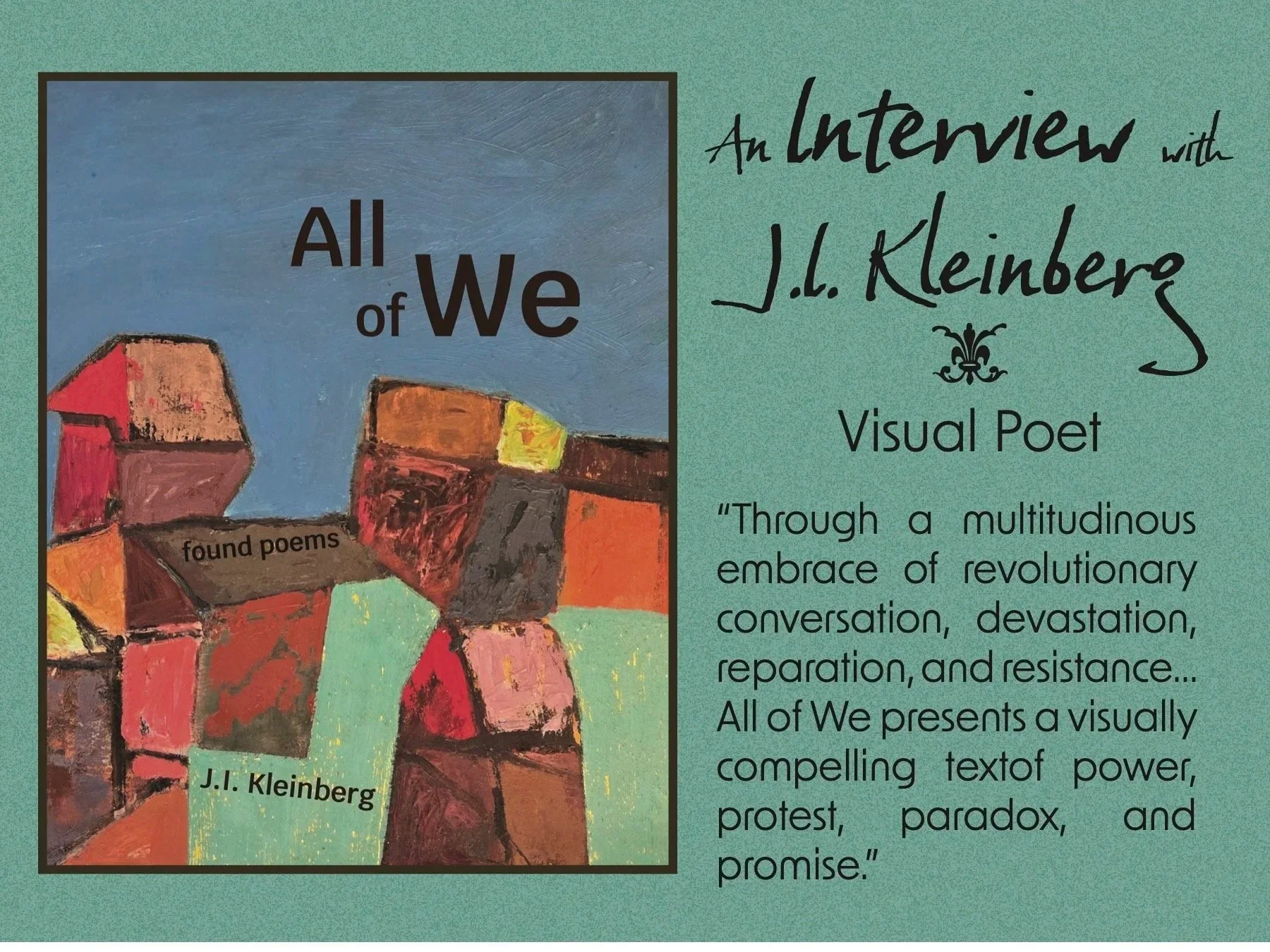
Our interveiw with J.I. Kleinberg
The poems featured in All of We were created over 15 years of harvesting patterns you notice in pages of magazines. When did you know that you wanted to curate these poems into a published collection?
Actually, All of We came together fairly quickly. I’ve been finding my way into this method of making poems for about 15 years, and while there are many recurring themes over those years (birds, light, the political and environmental climate, love, Emily Dickinson, etc., etc.), the poems in this volume were created in a matter of months, with very focused intent.
What was your experience working with Anhinga Press?
Anhinga is great! I’m a person who notices fussy little details and asks a lot of questions. The response from Anhinga was consistently professional and reassuring, patient and prompt. Plus, of course, I’m thrilled with the book itself, and throughout the process felt that my work and ideas were respected and appreciated.
With so many different ways to format and present these poems, how did you land on the final look of All of We?
One of the elements that was established early in my found poem work was the use of this soft green background. It acts as a neutral color in this context, not distracting or requiring too much attention, and allows the text fragments to show well in contrast. So that was a given, then, like any collection, it was largely a matter of figuring out the sequence of pieces, adding and eliminating until the set felt complete. I was especially pleased that Anhinga agreed to use one of my mother’s paintings for the cover, which contributes a lot to the final look of the book.
The shapes on the page create a feeling of loneliness or connectivity depending on the poem. What was your process for using visual shapes to enhance your message?
Each torn fragment is meant to be read as a discrete line of poetry and each poem is a sort of cascade of lines. The visual element is important; the words are objects and the collaged shape is deliberate, showing the way through the poem. Some poems are quite stark, with a lot of empty space, which I think of as silence surrounding the words. Others are more chaotic or noisy, and while the reading sequence favors English-language readers—left to right, top to bottom—in some cases it’s not absolutely clear where to start. That’s okay. Start somewhere upper left-ish and let your eye read its way to the bottom, one line at a time.
Themes of this book include climate change and politics. How does your book act as a sort of call to action?
We seem to be living in a time of growing disharmony, disunity, self-aggrandisement, and blaming. All of Weasks the reader to recognize that each of us is part of a larger “we” that takes in human and non-human, past and present. A “we” that acts with empathy, accepts responsibility, recognizes consequence, moves toward connection.
How did you decide which order to present the poems in order to create a cohesive journey through the book?
The book’s syntax uses “We the people” phrasing from the preamble to the U.S. Constitution. All of We opens with a number of “We the people” poems, then gradually widens the possibilities of that phrasing to encompass many expressions of “we.” Searching through magazines for these “we” lines was a process of expanding my own understanding of “we.” The sequence of poems in the book invites the reader to share that enlarged, and still growing, definition.
What's one takeaway you'd like readers to get from your book?
I’d like to think that these poems open a window that lets us look outward from the habits of isolation, separation, and division, onto a more spacious world view with room for everyone: all of we.