

J.I. Kleinberg
J.I. (Judy) Kleinberg grew up in Los Angeles, earned an M.A. in Design at U.C. Berkeley, had a long career as a fiber artist, worked as director of marketing for a large corporation, taught scuba diving, ghost-wrote a memoir, co-edited Noisy Water: Poetry from Whatcom County, Washington (Other Mind Press), and has worked as a freelance copywriter for nearly 30 years. Along with her personal site, ChocolateIsAVerb.wordpress.com, she has posted a regional poetry blog, ThePoetryDepartment.wordpress.com, almost daily since 2010, and co-produced the Bellingham-based SpeakEasy poetry reading series with Luther Allen.
Kleinberg writes both conventional-form and visual poetry. Her work is widely published in journals and anthologies, and collected in four chapbooks and a full-length volume. Her visual poems have been featured in two solo exhibits: The poem My trembling candle at Beyond Baroque, Venice,
California, April/May 2026, and orchestrated light, at Peter Miller Books, Seattle, Washington, May 2022. Her work was displayed at the 2022 Skagit River Poetry Festival; in The Cutting Edge: Art of Collage in Asheville, North Carolina, in 2023; and in Ink, Paper, Scissors: nature speaks in three voices, in Bellingham, Washington, in 2024. In addition to private collections, four of her found poems are in the collection of the Fifth Avenue Hotel in New York City, where they are displayed in the McKim, Mead & White-designed Mansion. Judy Kleinberg lives in Bellingham, Washington, USA. For more information, visit chocolateisaverb.wordpress.com. For more about her visual poetry process, see the interview in The Journal of Radical Wonder at medium.com/@jikleinberg.
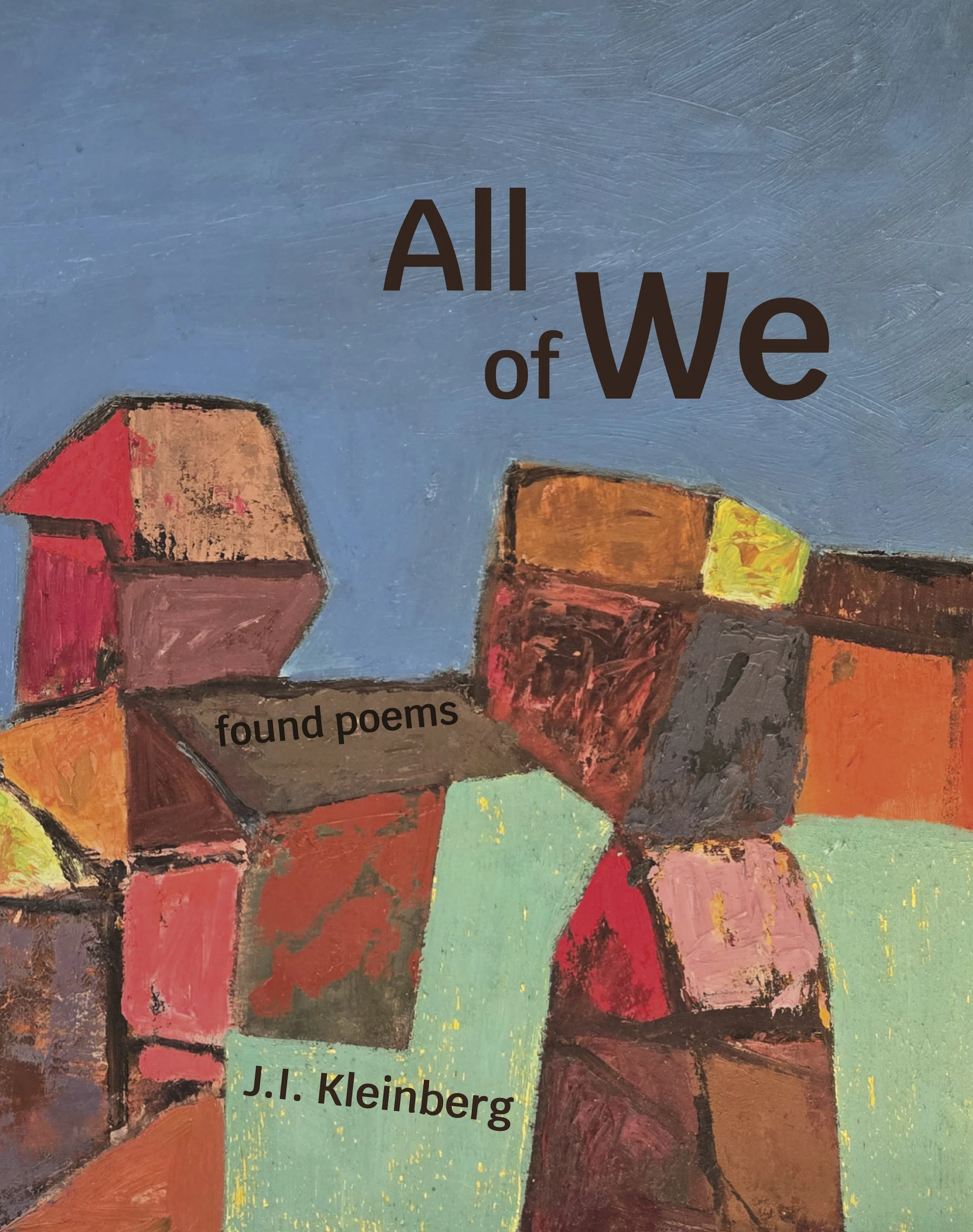
ALL OF WE by J.I. KLEINBERG
$28
About All of We
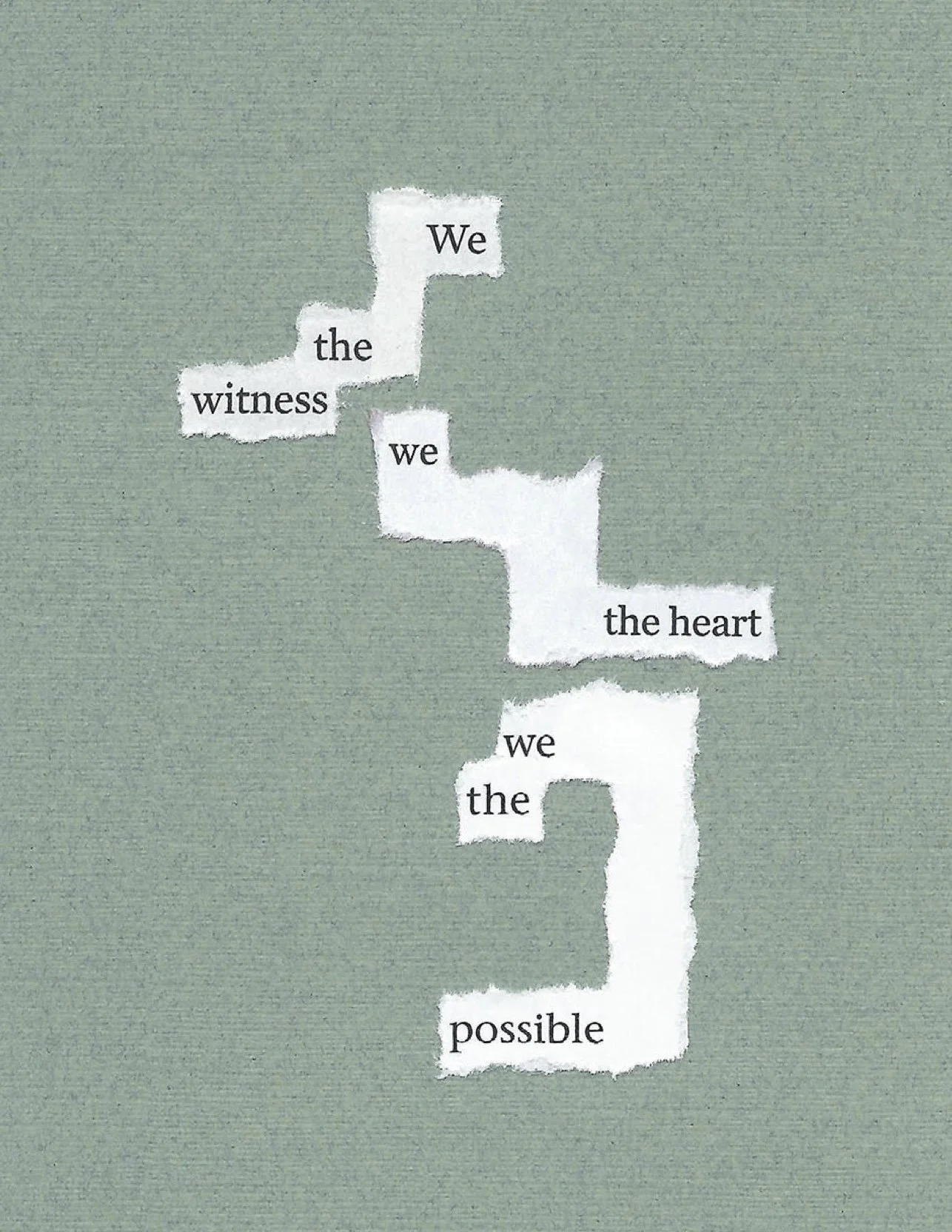
The visual poems in All of We are part of J.I. Kleinberg’s expansive series of collages built from phrases that occur through the happenstance of magazine page design. For more than 15 years, Kleinberg has discovered, harvested, and recast these accidental lines into visual poems that find themselves at the intersection of Dada and Twitter, ransom note and haiku.
Within the poems, each contiguous fragment of found text is literally torn from its original sense and syntax and meant to be read as a poetic line. Kleinberg generally begins without a subject in mind. “I wait to discover what the magazine page has to tell me.” The All of We series began with the found line, We the ocean (page 50). “There was a column break between We and the ocean, but I read across the gutter and recognized that familiar ‘We the people’ syntax.”
“I had already been thinking about the current rhetoric of otherness and blame – the narcissistic I, the accusatory you, the divisive they. And the embracing we that acknowledges our flaws, mistakes, and losses along with our potent creative abundance.”
Once she identified that distinctive language, Kleinberg searched for more examples. “I probably collected around 500 of these lines, saying to myself, Yes, we are this and this and this.” Then, as with all the found poems, the lines had to find one another, fitting together in pairs and triads, shuffled around on the work table and the green background until they could be called poems.
The series could go on and on; All of We is a selection, a beginning, an invitation to inclusiveness.
Through a multitudinous embrace of revolutionary conversation, devastation, reparation, and resistance, J.I. Kleinberg’s arresting All of We presents a visually compelling text of power, protest, paradox, and promise. Punctuated with colorfully re-constituted fragments of wounded syntax—where each ripped fragment, a poetics of witness—All of We poignantly exposes how the “we” contains the “me” and all that is ripped / rapt / wrought / fraught in the fragility of our contemporary socio-political condition.
— Adeena Karasick, Professor of Literature and Media Studies, Pratt Institute
To enter All of We is to step into a temple—a meditative space where we’re invited to sit, to slow, to contemplate that tiny word: we. “We” begins every phrase in this series of found poems, beautifully and painstakingly arranged against a grey-green wordscape. “We” is repeated so often that it blurs, fuzzes, loses meaning, then resurfaces in our consciousness with new complexity, vitality, urgency. In a time of extreme division, when we’re quick to monstrify, to other, what more important work is there than what Kleinberg undertakes in this book—the work of centering our shared humanity, our collective of “warts and wounds,” pointing us toward our capacity for empathy and change and hope.
— Dayna Patterson, author of If Mother Braids a Waterfall and O Lady, Speak Again
This book is a marvel. J.I. Kleinberg’s All of We is a remarkable collection of found poems that operate on two levels—both as language and as visual art. The words engage us as more than mere readers. We are active participants, emotionally, intellectually—and viscerally—involved. In other words, all of us are the all of we.
— J.R. Solonche