
Terri Witek
TERRI WITEK is the author of seven previous books of poems. Exit Island was a Florida Book Award medalist; The Rape Kit won the the 2018 Slope Editions Prize, judged by Dawn Lundy Martin. Martin called The Rape Kit “a grand success, the best we’ll get. Fresh, relevant, and heartbreaking” and “a fire in the throat of a culture that has no appropriate language for rape and its aftermath …” Witek’s poetry, though often topical, traces the breakages between words and visual images. Her visual poetics work is featured in two recent international anthologies: JUDITH: Women Making Visual Poetry (2021), and WAAVe Global Gallery of Women’s Asemic Writing and Visual Poetry (2021). It has appeared in museum and gallery shows and in site-specific performances as well, often in collaboration with visual artists. With Cyriaco Lopes, Witek team-teaches Poetry in the Expanded Field in Stetson University’s low-residency MFA of the Americas. They also run The Fernando Pessoa Game as faculty in the Disquiet International Literary Program in Lisbon. Witek also directs Stetson’s undergraduate creative writing program, and holds the university’s Sullivan Chair in Creative Writing. (terriwitek.com)
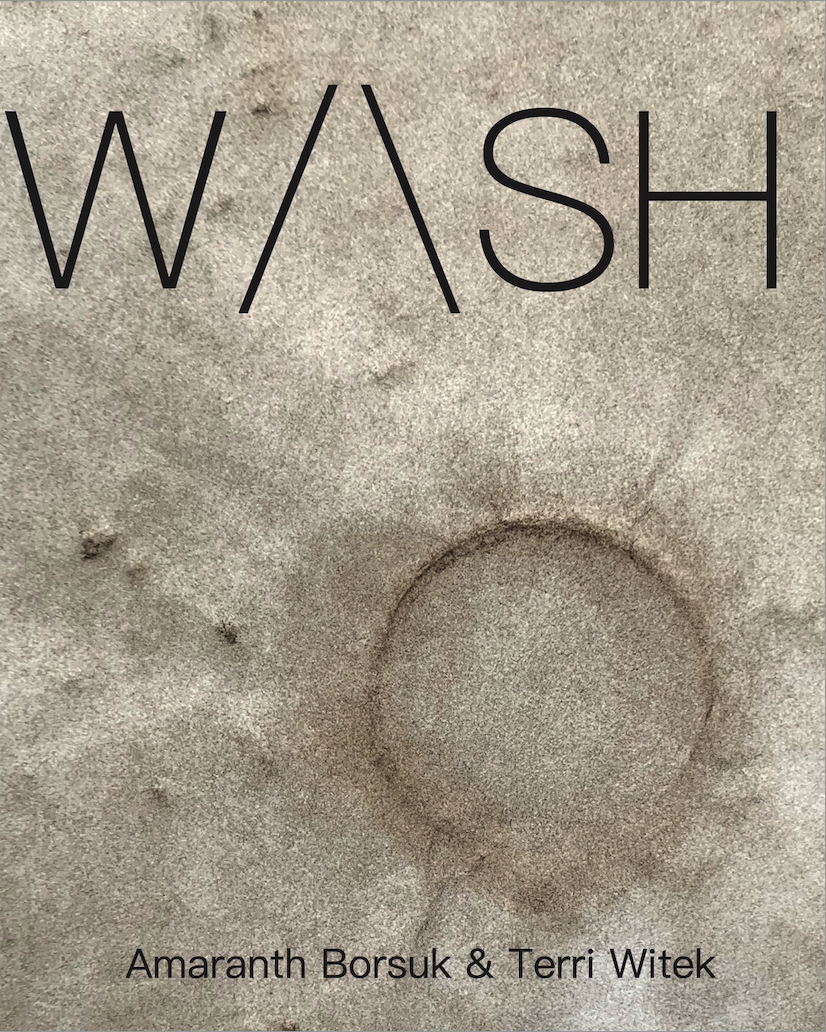
W/ \SH BY AMARANTH BORSUK & TERRI WITEK
The Citizen of No Rain and the Denizen of Skyshot: two mothers—rain philosophers— trying to figure equations of damage when “the weather outside becomes the weather within.” Their message trails loop from the pan-pipes of Ancient Greece, to Apollinaire’s calligrammes, to our present atmospheres of rain and smoke, water and ash. Read closely for clues to our eco-future in these epistolary transmissions from the umbrella end-times. What a quirky, wonderful book. -Jena Osman
W/\SH is a beautiful, brilliant, visionary poem structured as an archive of correspondences between two mothers in a future a few hundred years from now, gathered by an archivist in an even farther future. Thus, the poem casts its speculative gaze backward as much as forward; it asks how we come to inherit our origin stories, given that any of our possible futures will be built as much on mythology as technology. W/\SH’s assembled fragments compose not only a textual archive, but a tactile, visual, aural one, testifying to the lingering materiality of long-gone bodies and voices, and to conditions of pressure that shape not only individual people but also the choices available to whole societies. Thus, the poem is also a fine-tuned inquiry into how to read—how to sift out from white noise the communications we may need in order to survive, how to glean what we need to know from the pockmarks shadowing a piece of paper or the recorded sounds of someone else’s life. Borsuk and Witek track myriad crossings back and forth over permeable boundaries: breath moving between body and environment, radio transmissions between a drenched world and a world in severe drought, experiential wisdom passing from older generations to younger, but also back the other way. Knowledge comes from the weather, from grandmothers, from children, from strangers. At its best, speculative literature operates as a divining rod, seeking out what constitutes human nature. What are we really made of? W/\SH answers that we are made of a desire to reach and recognize each other, and to hold each other together. Collier Nogues
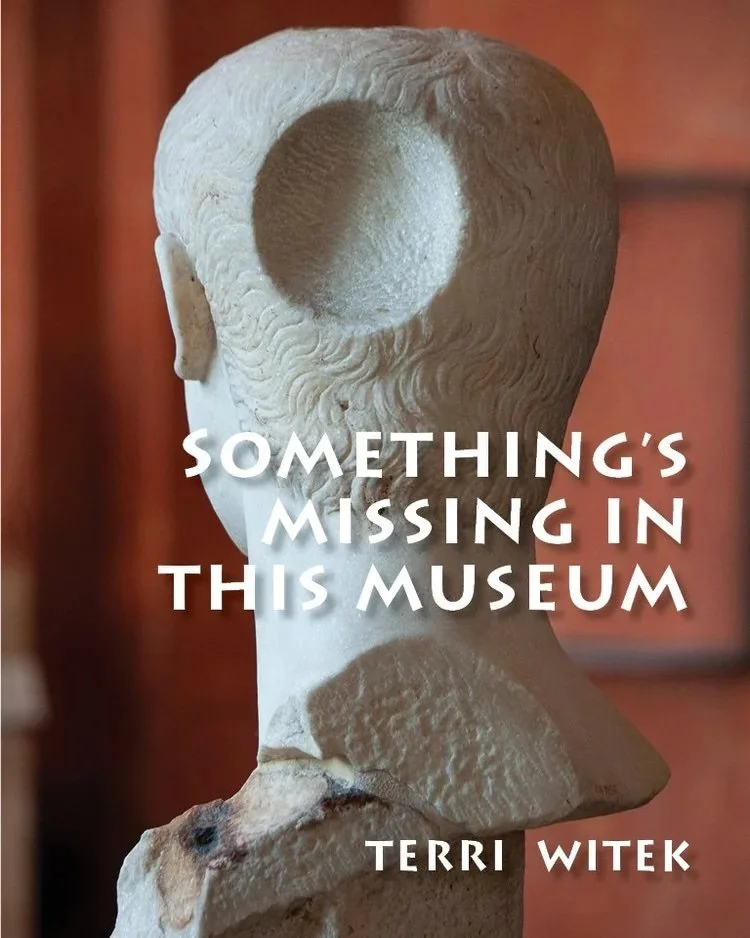
When texts about paintings try to reach each other across space, pages that query how we experience art become poetic experiments in seeing/reading. What clings to what on these page walls? And do paintings from other centuries (older materialities, differently-moving) themselves re-make each other through their almost touch? Are we momentarily part of a painting when we consider such things? And what’s the changing position of the museum which poses us by country, by technique, by year and by foot pattern? In Something’s Missing in This Museum, the subjects are love, torture, transaction and time.
Vermeer
Table is wound. Globe is wound — that country where your hand rests is the throb
of it. You have a fingering thought and it’s wound.
Chair is bent and slower wound, floor is unseen so it’s flood not wound
but thread canyons are wound — vine-bloomed drape at that fold
where you grip its slide over table. Second degree wound, then, or third:
air gone wound as you pass through it, wound the room where you pause and
pause. You look away, light — light wounds.