
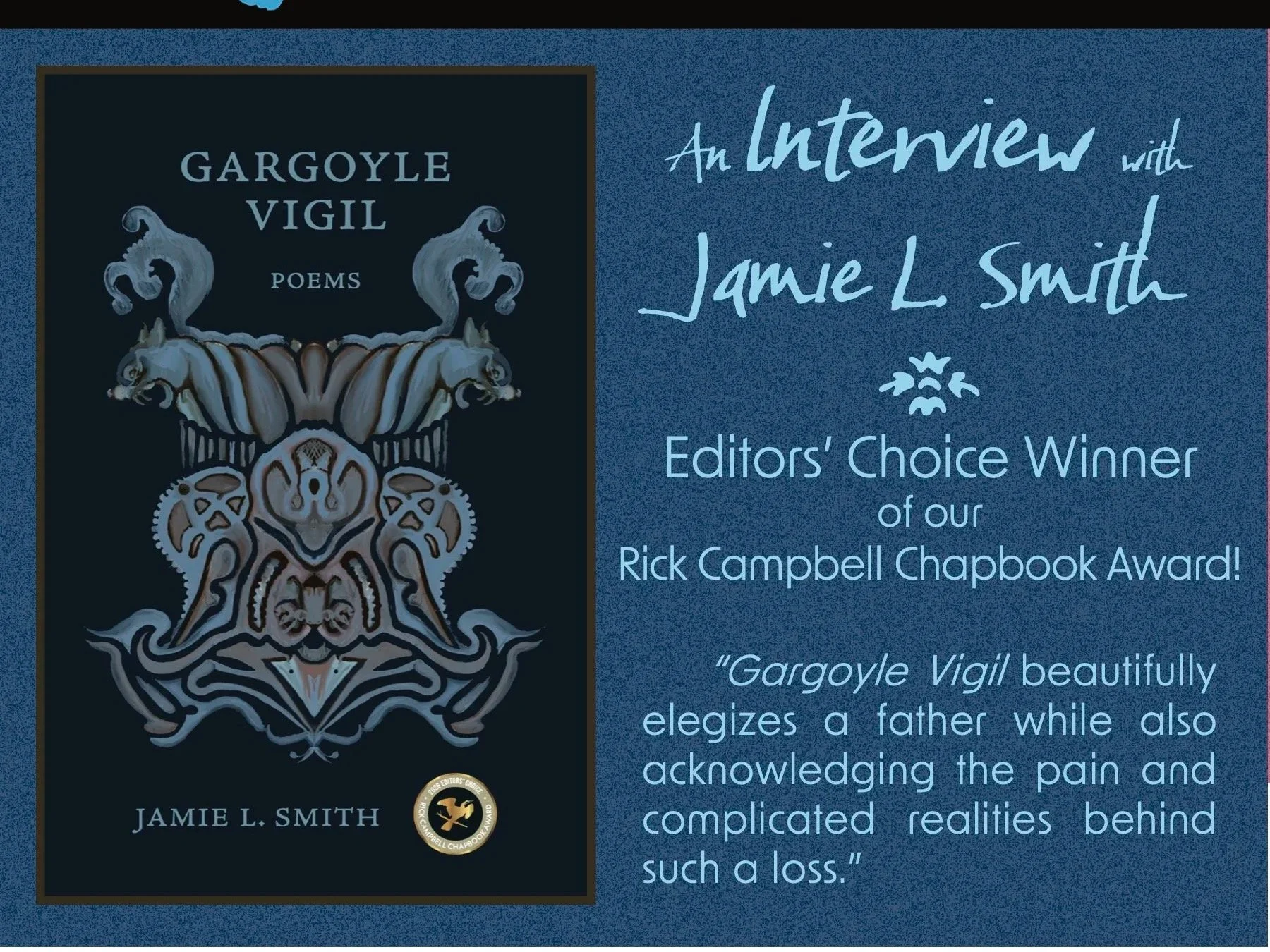
Our interveiw with Jamie L. Smith
What was your experience working with Anhinga Press?
Anhinga has been wonderful. I’ve thought highly of the press for a long time and was very excited when I received Karla’s email about the acceptance. I’m grateful these poems ended up finding a home here. Lynne Knight has been a fantastic editor to work with. She told me she thinks of herself a poetry doula and it’s an apt description. The artwork she created for the cover was also so generous and thoughtfully designed.
Gargoyle Vigil is inspired by your father’s passing. When did you first have the idea to translate that experience into poetry?
Some of these poems began very shortly after my dad died. My friend, the wonderful poet Chengru He, was leading a Lunchtime for Writers workshop with the Huntsman Cancer Institute at the University of Utah. She had asked me to participate, and when I sat down to write, the first group of poems began. For several months, this was the experience I couldn’t write beyond, and I think the early poems helped siphon out some of my grief or at least channel it more thoughtfully. As the work grew and I revised, it helped having something tangible to manipulate and puzzle out, and the work gave me a way of remaining in conversation with my dad that felt right and kind of necessary at that time.
Although the emotional tone of the book is based in grief, there are also moments of fond remembrance and reflection on happy memories. How do you strike that balance?
The vast majority of my experience with my father wasn’t sad, or complicated. We loved each other. We both struggled at different points, as all people do, but my dad was funny and thoughtful, and he taught me to look at the world with amusement and to try to find beauty to focus on in difficult times. Following his death, I was devastated, but also surrounded by loving, intelligent, uplifting friends and mentors. Poetry itself always helps me find gratitude—poems are multifaceted, and leaving out the light is usually a disservice to their enactment of the human experience.
I took a cartooning workshop with Lynda Barry years ago, and the question she asked that has always stuck with me, whether writing or making visual art, is “Where is the light coming from?”
Was it challenging writing from such a deeply personal and emotional place and sharing it with the world?
I should say yes, but the answer is no. When I told my dad I’d gotten into an MFA program he said, “It’s no longer a question of if but when you’ll bring shame to our family,” and he laughed. He was kidding but also giving me permission in some way.
The world I’m writing to is also pretty small. I’m writing mostly to poets, people who are devoting time to reading poems, and people who already live in these pages. Poetry is a conversation, and grief is a universal experience, so I knew I’d get something back by casting that line, even if it wasn’t necessarily publication. The first most meaningful thing someone ever said about one of my poems was, “This helps me.” Making these poems helped me, and my hope is that their being out in the world apart from me will help somebody else in some way.
How did the process of writing this elegy change your relationship with your memories?
Many of these poems are rooted in conversations I had in the days leading up to and following my father’s death. Putting them on paper gave me an anchor. One of my mentors, Tom Sleigh, is fond of quoting Derek Walcott’s line, “Most poems are failed attempts at resurrections.” There’s no piece of writing sufficient enough to bring our loved ones back, but writing does give us a way of capturing pieces and reassembling them into something we can experience in a new now, from a different perspective. Memory is always a revision. Attaching actual revision to the process acknowledges that fact in a way that makes me feel greater agency in the meaning-making process. The poems I won’t yet write help me know where I have some personal work to do.
Your book carries the theme of nature, animals, and the natural world throughout several poems. What role does nature play in your art, your work, and your life?
I’ve always loved animals. My dad did too. He was an avid fisherman. He and my stepmom had a hippotherapy stable when I was an adolescent, and I’m lucky to have gotten to grow up with dogs, cats, horses, and all the wildlife in a Vermont back yard. I’ve spent most of my life since living in New York City and other major metropolitan areas, so I’ve always been attentive to synanthropes—hence the rats and pigeons.
Animals are nonverbal but often very clear communicators, and I think they have a better handle on the experiences language wasn’t made for than we do in some ways. They’re connected to both joy and grief for me, but also wholly and perfectly themselves regardless of what anyone may try to project onto them, and that’s beautiful.
Gargoyle Vigil contains poems with very different structures. How did you choose which way to structure each poem?
At the time I began these poems, I was writing my dissertation, Trojan Horses: Voices from the Opioid Crisis. Part of that book occurs through transcripts of group therapy sessions and lunchroom conversations between clinicians. The earliest versions of the Gargoyle poems were written as transcripts as well. They began with the dialogue I had with Mike, the night nurse on duty at North Country Hospital when my father was dying.
The tanka were a way of trying to give myself structure to contain the memories I was having greater difficulty articulating or finding meaning within. I’m interested in the idea of urban tanka, the juxtaposition of a clean syllabic count and the grimy unwieldiness of certain environments and experiences. That simultaneity intrigues me. It feels truer to my experience of the world and my own mental landscape than the unrestrictedness of free verse.
Beacons and the couplet poems were more intuitively structured. Rhyme helps hem them in, but couplets are a form of ease for me. They turn freely and they’re closer to the rhythm of my thought patterns and speech than either syllabics or the more transcript-based pieces.
What's one takeaway you'd like readers to get from your book?
Know your beacons.
Finally, are there any upcoming projects or events you'd like to shoutout?
I’d like to give a shoutout to Ellen Kombiyil’s new Anhinga collection, The American Journal of Insanity's Diagnostic on the Plumbing & Wiring of Females. I’m also very excited about Allison Field Bell’s new project, Field Works Writing which offers workshops, retreats, and new opportunities for writers to build community beyond the academic sphere. Donna Masini’s newest collection, Did You Find Everything You Were Looking For? and Paisley Rekdal’s Heritance are absolutely wonderful.
As for me, Gargoyle Vigil is still growing into a full-length, so that’s the next task. I’m also working on a hybrid project based on my time in South Korea and Japan called Paper Cities that centers on the experience of expatriation and the transgenerational legacy of atomic warfare. This collection includes both written and visual sijos created using transparent adhesives, mica, sea glass, and a beam of light. I’m abysmal at booking launches and planning events, but when I do, I’ll post the schedule on my website: www.jlsmithwriter.com