
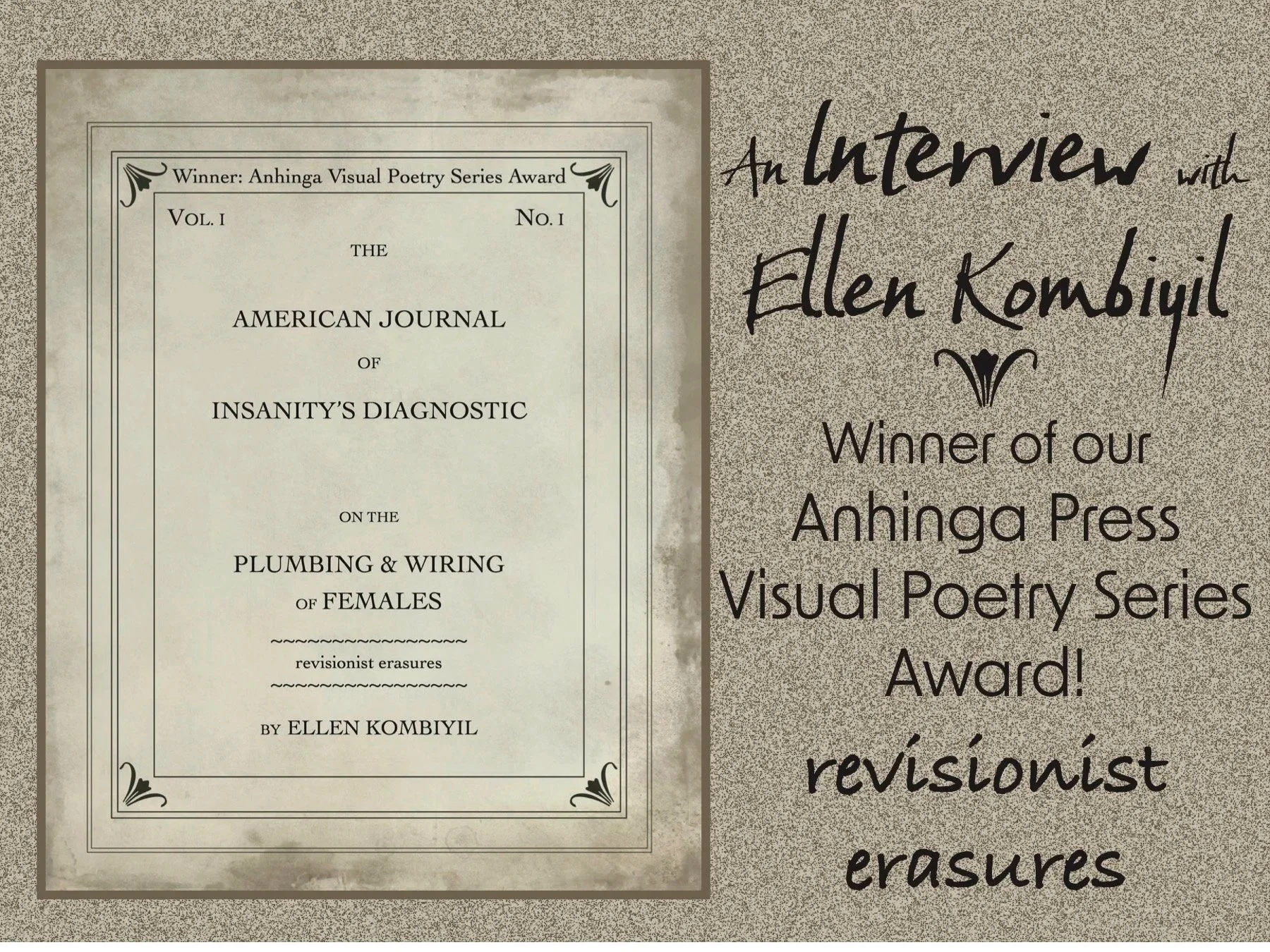
Our interveiw with Ellen Kombiyil
What was your inspiration for creating The American Journal of Insanity’s Diagnostic on the Plumbing & Wiring of Females?
The project began when I read an article in the New York Times, which casually mentioned that The American Journal of Psychiatry was once called The American Journal of Insanity. They only rebranded in 1921. Immediately I knew I had to search the archives for articles that I could fuck with through erasure, additive elements, and collage.
As a collage artist, I collect all sorts of ephemera that interests me, for use at a later time, for as-yet-to-be-determined projects. I’d been holding on to a vintage electricity guidebook, replete with diagrams involving some very gendered depictions of women watching male scientists perform experiments, or a woman using an electric curling iron while a man is performing tasks with an electric soldering iron. I knew these diagrams needed to be in conversation with the articles I was erasing.
For this book, I focused on erasing two different articles: “On the Mental Disorders of Pregnancy and Childbed” (1851) and “The Insanity of Women Produced by Desertion or Seduction” (1866).
I have recombined these texts with diagrams from a steam pipe apparatus and the electrical handbook in order to create a new, surreal guidebook for diagnosing the bodies of women.
What was your experience working with Anhinga Press?
They did a beautiful job with the book design and layout (thanks especially to Karla Van Vliet, who approached this with her exquisite artist’s eye) which is so important for visual poetry! I love that this book found a press that truly champions visual poetry.
How did you get into visual poetry?
Before I wrote this book, I wrote a full-length manuscript called My Prayer a Slit Throat that began by erasing The Iliadthen expanded to include other texts, including handbooks on war and ROTC manuals. I describe this project as “erasing war” as it has been handed down to us throughout the western canon, beginning with The Iliad, our first preserved major work that pre-dates the widespread use of writing. There is no doubt that The Iliad is a major achievement and a book so filled with beauty and horror—co-existing—but that it is also an epic focused on war, and concepts like honor, and gender. I was interested in examining our inherited thinking, and making it strange to us again through erasure, found/made/revised diagrams, and collage, in order that we might see it new.
That the erasures demanded a visual element made me go back to art classes to get comfortable again in the visual arts. I had been a visual artist in high school and college, but had not practiced it in decades. I love the hybrid nature of these projects in that it allows for different ways of knowing and thinking to emerge.
Your book contains powerful visuals that expose prejudiced ideas of womanhood published in the 1800s and 1900s. How do you feel these ideas still impact women today?
This is the question, isn’t it? The sad truth is that not much has changed. Gender bias and medical sexism is a huge problem (research shows 1 in 3 women have had their symptoms dismissed by a medical provider). Women’s health research is severely underfunded or worse—ignored altogether. Women have lost so much autonomy over their bodies with the reversal of Roe v. Wade. And the reality is that these outcomes are far worse for women of color. The problem is that these attitudes are systemic. Again, it’s about examining inherited thinking. What are the narratives that have been passed down and continue to exist, unexamined? I’m making them stand out in all of their absurdity so that we can truly see them.
Your use of colorful visual art throughout highlights the absurdity of the ideas contained within the text used. What was your process for choosing how the poems were visually arranged?
I approach each page as its own unique canvas. For me each page is an act of discovery. What words can be found on that page? What diagrams or images want to sit in juxtaposition to those words? It’s an immersive process of discovery.
The exposure of the ways in which women were medically and systematically oppressed is very dark, yet you also build a sense of solidarity as you satirize those outdated ideas in a somewhat humorous way. How did you strike that balance, and what was it like building that emotional journey?
Often when I work on these projects, I am looking for something that makes me laugh when I notice it, or laugh when I pair the image with the words. That is usually the sign for me to proceed. Even though the subject matter is dark, humor drives it, as a way to unmask it.
What is the revision process like for works that are so abstract?
Sometimes I re-do a page several times until it feels right. For this book, because it’s dealing so much with the idea of the “feminine”, if I wanted to redact even more that I originally whited out, I used embroidery thread to sew patches over words. I like the idea of a redaction of a redaction. And using different methods to do so.
What’s one takeaway you’d like readers to get from your book?
I hope to inspire readers to keep exploring areas of hybridity to talk about difficult subjects.
Finally, are there any upcoming projects or events you'd like to shoutout?
I will be attending the inaugural Poets for Science gathering at Kent State University in November, where I will be presenting on erasure, form, and scientific technique. It looks like a stellar lineup of poets and I can’t wait to present some of my work. I also have new formal experiments, including a visual zuihitsu, coming out in Grist Journal as the 2026 winner of their ProForma contest, so look out for that!