
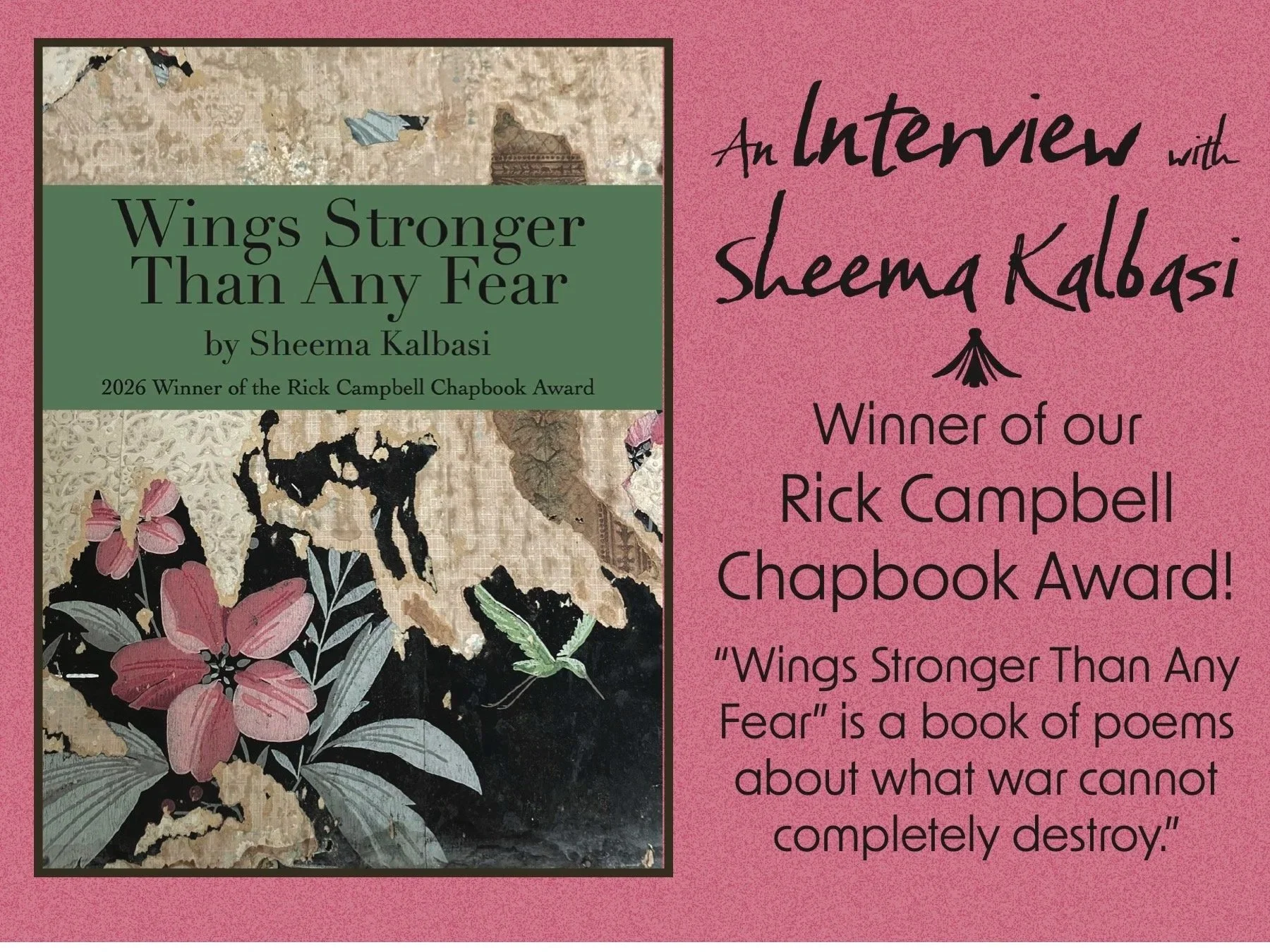
Our interveiw with Sheema Kalbasi
What was your experience working with Anhinga Press?
Working with Anhinga Press was a respectful and collaborative experience. My editor approached the manuscript with remarkable attentiveness and discernment and never lost sight of the integrity of the work.
Wings Stronger Than Any Fear is about your experiences in a childhood shaped by war. When did you know you wanted to write about those experiences?
I have been writing about war and its consequences for more than two decades. I lived through eight years of the war imposed on Iran: the aerial bombardments, the air-raid sirens, and the internal displacement of families fleeing from one city to another in search of safety. War also does not end when the bombs stop falling. Its emotional and psychological aftermath persists long after any ceasefire.
My understanding of displacement deepened later through my work at the United Nations, where some of the cases I encountered involved people who had fled war and conflict in places including Afghanistan, Iraq, Somalia, and Russia. Their circumstances were distinct from my own, but encountering the human consequences of war across different countries reinforced for me how much survives beyond the immediate violence: displacement, separation, uncertainty, and the difficult work of rebuilding a life.
People often think of war only as explosions and casualties. It is also deprivation: food, fuel, and necessities rationed into scarcity. It is the anguish of escape and the precarity of displacement. In my case, it was also the experience of growing up under a repressive regime while simultaneously enduring an armed conflict. Civilians, and children above all, were subjected to a double siege, one from beyond the borders and one from within. International humanitarian law exists precisely because civilians are meant to be protected persons in armed conflict, yet children so often absorb its most enduring harm. Writing became my way of bearing witness to that harm, and of insisting that the interior lives of civilians, especially children, deserve to be recorded.
How has writing this book transformed your relationship with those memories?
I think of it as a process rather than a destination. Writing has not erased these memories, nor would I want it to. What it has done is change their architecture. Traumatic memory tends to be fragmentary and intrusive. Writing allows me to give those fragments form, sequence, and language, so that I can hold them, examine them, and set them down on the page.
There is also a reclamation in this work. As children, we were rendered powerless. As a poet, I can choose which image to linger on and which detail to preserve. I can decide that a single white feather found beneath a playground slide deserves as much attention as the bombs. In that sense, writing has allowed me to transform memory from something that wounds into something that testifies. It is slow and recursive work. Like the starfish in the book, regeneration happens gradually, and never quite in the original shape.
What role does nature play in your art, your work, and your life?
Nature plays an essential role. I grew up in Tehran, a city that lies at the foot of the majestic Alborz Mountains, so the natural world was never something distant or abstract to me. It was the constant backdrop of daily life: snow-crowned peaks above the city, seasons visibly turning on the slopes, the sense that something vast and ancient stood watch over us. My parents loved nature deeply, and we spent a great deal of time exploring it together. Those excursions instilled in me a reverence for the natural world and an attentiveness to its smallest details.
That reverence is also woven into Iranian culture itself. Many of our most cherished celebrations are ancient observances of nature and its cycles. Nowruz, the Persian New Year, arrives with the vernal equinox and the rebirth of the natural world, and its celebrations culminate in Sizdah Bedar, when families spend the day outdoors in celebration of nature; Tiregan, a summer festival, celebrates water and rain; Mehregan coincides with autumn and the harvest; and Shab-e Chelleh marks the winter solstice, when families gather through the longest night to await the return of light. I grew up with nature as something bound to family, culture, celebration, and our understanding of time. It is perhaps inevitable that it became one of the languages through which I write.
Your poem The Girl Who Lived Under The Sea references the tale of the Little Mermaid. Are there any other stories or media that influence your writing?
Hans Christian Andersen. As a child in Iran, I read his fairy tales in Persian translation, long before I was able to read them in the original Danish. Encountering his work first in translation and later in his own language gave me a layered relationship with his stories.
“The Little Mermaid” affected me most profoundly. Unlike the sanitized adaptations many people know today, Andersen’s original is a deeply melancholic tale. The mermaid surrenders her voice, the very instrument of her selfhood, for the possibility of love, and she suffers silently with every step she takes. The idea of a girl rendered voiceless by a bargain she cannot undo left an indelible impression on me. As an adult, I recognize how closely that image corresponds to the experience of children in war, and of women living under repression, whose voices are so often stolen or suppressed. Much of my life’s work, including my translations and anthologies of Iranian and Danish women poets, has been an effort to restore voices that history tried to silence. In many ways, I am still answering the question I ask in the poem: whether the girl from the sea ever found her voice again.
What would you say is the biggest way these childhood experiences have impacted you?
Anyone who survives war, regardless of age, carries its imprint. Children, however, are especially vulnerable, because war reaches them while they are still developing cognitively, emotionally, and neurologically. Their understanding of safety, trust, and the world itself is formed under conditions of chronic threat. When such children survive, the effects frequently manifest later in life: hypervigilance, a heightened startle response, intrusive memories, anxiety, disrupted sleep, and in many cases post-traumatic stress or complex trauma. The body learns to remain on alert long after the danger has passed. As I write in the book, bomb-fear can become a second pulse.
For me, the most significant impact has been this enduring awareness of fragility: the knowledge, acquired far too early, that the world can split open without warning. That awareness has its shadows. I believe it has also shaped my sensitivity, my empathy toward others who have suffered, and my commitment to bearing witness. Many survivors also carry quieter burdens, such as survivor’s guilt and a grief for the childhood that war consumed. Those, too, find their way into my poems.
What advice would you give to someone with similar experiences as yours?
I am, by nature, reluctant to give advice, and I am not especially fond of receiving it. I believe each person’s path through trauma is singular and deserves to be honored on its own terms. If I were to offer one suggestion, however, it would be this: write it down. It does not need to be a poem, and it does not need to be shared with anyone. Write down the fragments, the images, the smells, the sounds, the small objects you held onto. Memory is fragile, and trauma tends to scatter it, so the act of writing gathers those scattered pieces and gives them a place to rest outside the body. What is written can be revisited, understood, and eventually, perhaps, made peace with.
What’s one takeaway you’d like readers to get from your book?
Hope. These poems move through bombardment, loss, and fear, but they are not, ultimately, poems of despair. They are about what survives: a feather kept in a pocket for months, a fig tree that insists on standing through winter, a child who rises to the surface even when the water is burning. If readers carry one thing away from this book, I hope it is the conviction that “even the smallest things make their way back to the sky.”
Are there any upcoming projects or events you’d like to shout out?
This has been a remarkable year. Alongside Wings Stronger Than Any Fear, my book Jahan Malek Khatun: The Princess Poet of Fourteenth-Century Persia has been published by Daraja Press, bringing renewed attention to one of the most accomplished yet overlooked women poets of medieval Persia. My chapbook The War Took Our Names was also selected for the Allison Joseph Series at Seven Kitchens Press.