
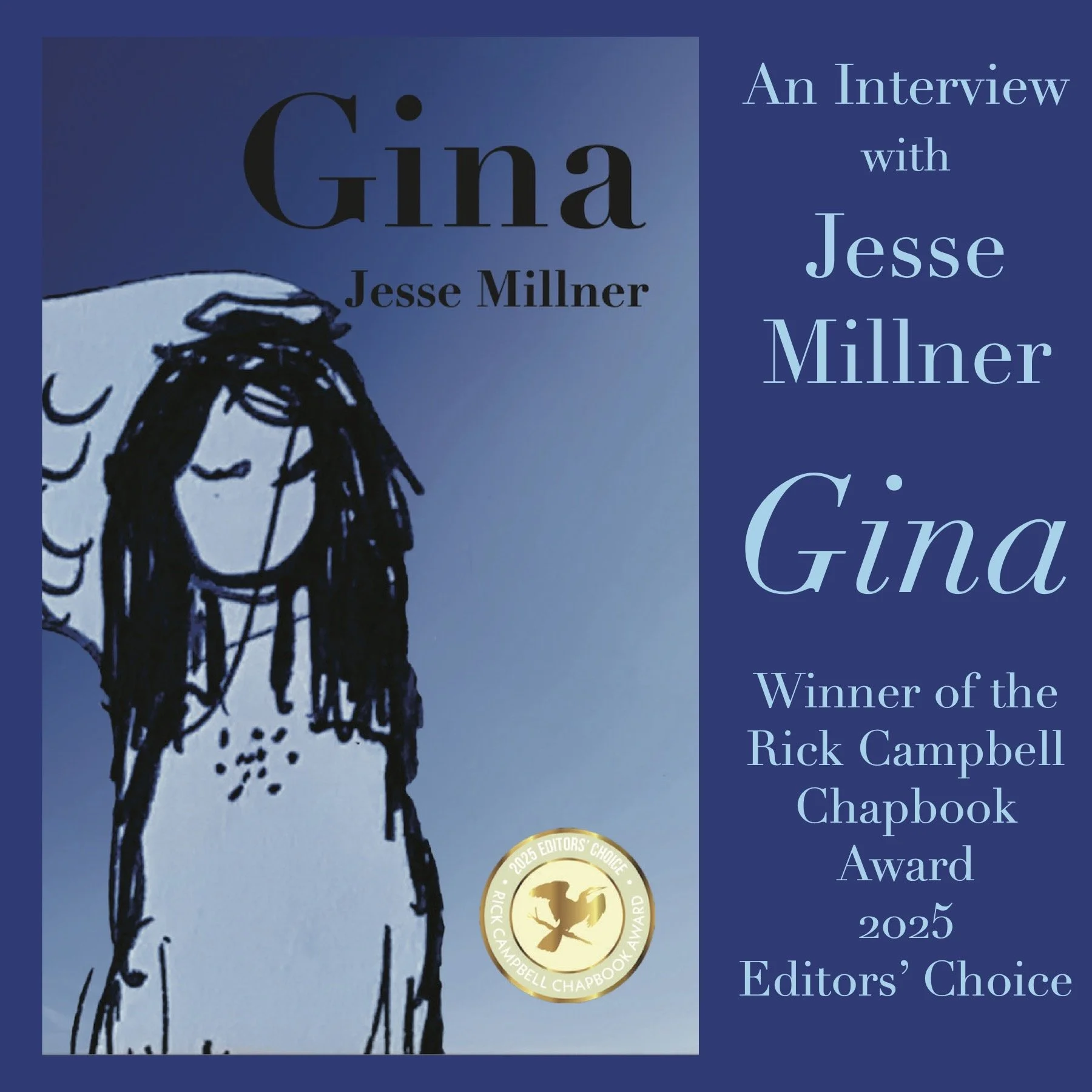
Our interveiw with Jesse Millner
What was your inspiration for writing Gina?
In August of 2024, I spent a week at a writers retreat in Rocky Mountain National Park. I hiked every day, went to workshops, and wrote a lot. During that retreat, I met Gina. She came to me in a fever dream and I wrote it all down in my notebook. Writing poems is hard most of the time. Gina spoke to me in one of those rare moments when it’s not so hard. It was like taking dictation from the unconscious, which for me, is the best and truest source of poems.
What was your experience working with Anhinga Press?
I’ve been writing and publishing for a long time. I’ve worked with a variety of small presses. Many of them were basically one human operations and labors of love for the people who ran them. They invariably were kind and supportive. I’m grateful to all of them. However, with Anhinga, I received a level of support I’ve never gotten before. Karla Van Vliet did the book design and she was amazing. I fell in love with her because she’s not only a brilliant poet herself and an outstanding artist, she’s also a perceptive editor. When I met her at AWP, it was a highlight of my life. I also very much appreciated Kristina Snodgrass’ support. Like Karla, she’s a poet/visual artist, and she was invaluable in producing Gina.
One of the more prominent themes in Gina is the struggle between industry and nature, and the impact of that conflict on society as a whole. What drew you to focus on that subject?
To be blunt, these days, I feel like there’s such an indifference (at best) to poetry and art, and in some cases there’s outright hostility. I teach at a college in Florida and like everywhere else, the liberal arts and humanities are being deemphasized for the sake of more “practical” majors. I think this attitude has led us to environmental degradation, war, and prejudice against “others” that is absolutely heartbreaking. I tell my students that only poetry and art can save the world, which admittedly sounds a little nutty, but I mean it. We’re up against industrial scale violence—against people, against democratic institutions, and against the natural world. I focus on that conflict because all that is truly beautiful and meaningful is being crushed. Poetry keeps me connected to what matters. I can’t imagine living in these bewildering times without it.
Some poems in Gina feel very grounded in reality, while others are more absurdist or stream of consciousness. How does your approach differ when it comes to different styles of writing?
When I look at all the poems I love, I see some combination of meaning and tangibility. If I read Lorca, I see “reality” interpreted in ways that are beautiful and frightening but always somehow tethered to the specific. You can be as weird as you want if there are “things” in your poem that convince the reader this is real. Like the TR Hummer poem, “Where You Go When She Sleeps,” poems are about falling—into a silo full of grain, falling in love—falling out of your “normal” human existence into the divine, which is beautiful, terrible, soul crushing, but ultimately somehow imbued with Grace. I try to mirror that in my own writing so that the “real” dances with the “absurd” and somehow the two together accrue meaning. As far as “stream of consciousness,” to me this is absolutely necessary in composition. When the poem is being spoken to me, I have to write everything down, follow every turn until I’m exhausted or I’ve found the ending place. Everything valuable and meaningful comes from the unconscious. This kind of writing allows me to access that richness. The trick is when I revise to not lose that feeling of “falling.”
Throughout the book you mention various gods, christian, greek, and otherwise. What role does religion play in your art, your work, or your life?
I grew up Southern Baptist. I will be worried about Hell and salvation until the day I die. That’s the gift and curse religion has given to me. But it’s also given me the King James bible and a wealth of stories. It’s given me a vision of a loving Christ as well as a vindictive God. I grew up reading Greek mythology and it seems to inject itself into my poems at moments that delight and surprise me. “Otherwise” is my main religion. Nature. Trees. Fungi. Flowers. Weeds. Birds, hummingbirds in particular. When I was a child, I saw hummingbirds in my front yard in San Diego. I have seen them every summer in Colorado. Years ago, I joined the Cult of the Hummingbird on Twitter. It felt right but then Twitter turned mean. It’s a cliché almost, but like Keats, I’ve resigned myself to living in the question and realized I have to be happy in the not-knowing.
Several poems refer to song lyrics or mention musical artists. What role does music play in your art, your work, or your life?
I love music. I think the musician who puts words to music is the ultimate artist. I listen to music while I’m writing! It doesn’t distract me. Instead, it fills me. And if I’m really lucky it spills out in my poetry from time to time. And I’m not only talking about the lyrical. It’s also phrases from songs that pop into my head that are connected to memory and meaning.
Although the emotional tone of the book is very heavy, there are also moments of levity and reflection on moments of joy. How do you strike that balance?
What a great question! I think about poems I love and usually there’s a humorous moment or at least a gesture that’s lighter than “heavy.” Isn’t that the nature of our lives? I’m always astounded at how, even in serious moments, there’s often something funny going on. So, when I’m writing a poem, I’m trying to show that range of emotion, how we move so quickly from sorrow to joy to laughter to melancholy. And I know as a reader I want that range.
What's one takeaway you'd like readers to get from your book?
Memory is alive. And poems are a way of living those memories again. And what’s cool: with poems what we remember doesn’t have to be “what really happened.” It can be a dream that is richer and scarier and more beautiful than the actual experience that might have triggered the memory.
Finally, are there any upcoming projects or events you'd like to shoutout?
I just read in Columbia, Missouri, and got a hummingbird tattoo. I’m waiting to hear from the Miami Book Fair and several other places about readings in Fall, 2026.