
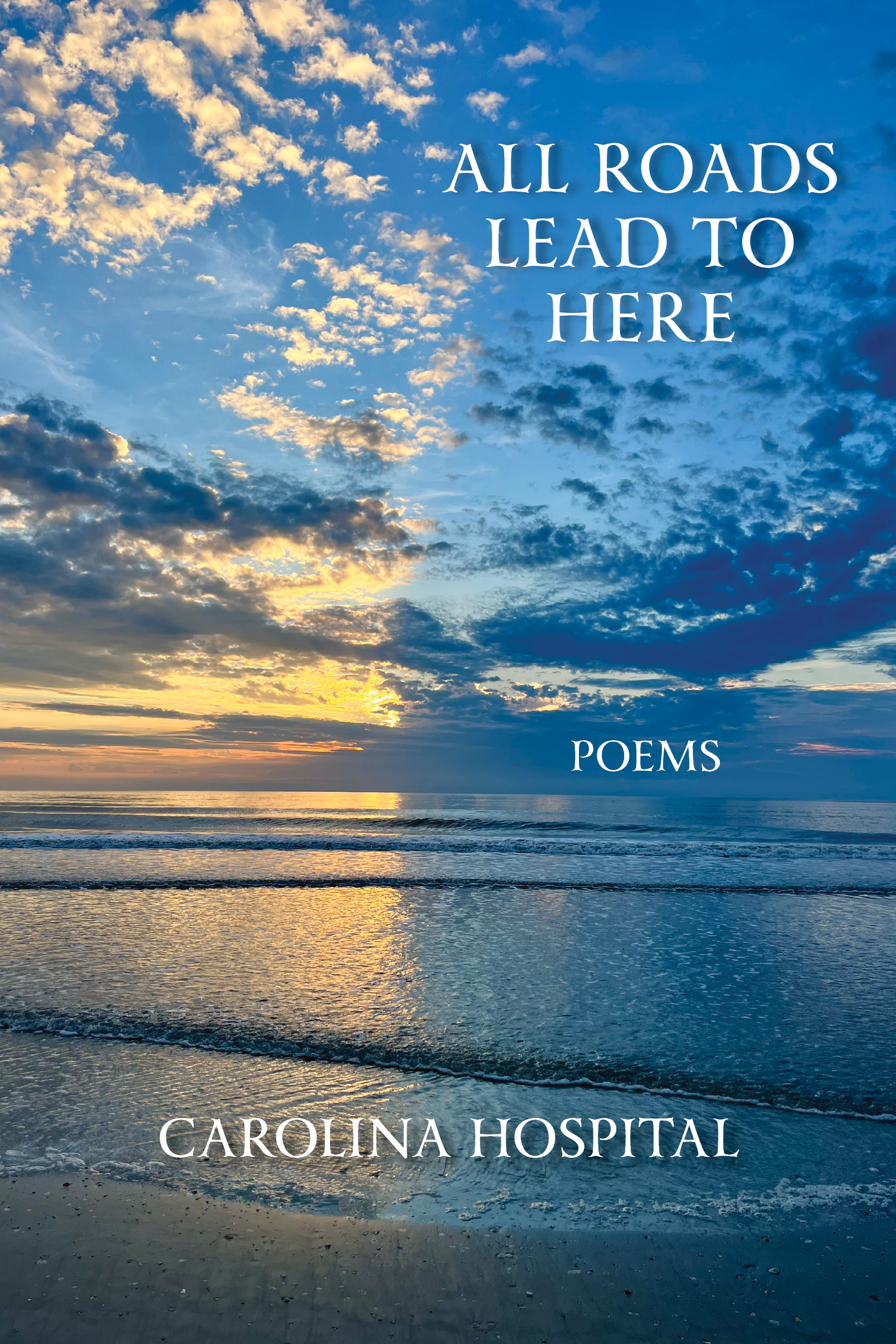
Our interveiw with Carolina Hospital
Interview with Jessica Fuller, Anhinga Press, June 20, 2026
What was your inspiration for writing All Roads Lead to Here?
Many things inspired the individual poems in the book: childhood, family, world events, travels. But when I reflect on it, most of the poems in this collection were written during my seven year weekly workshops with poets Maureen Seaton, Holly Iglesias, and Nicole Hospital-Medina, Tres abuelas y una mamá, as we called ourselves. So, I suppose you could say our time and work together was a significant inspiration for the book as a whole. The connections we made as women, collaborators, and supportive poets became a counterpoint to the external world. Being around such inventive and dedicated writers encouraged me to stretch in new ways.
What was your experience working with Anhinga Press?
I am so happy to work with Anhinga Press. As a young professor just starting to publish, I remember the excitement when a colleague, Ricardo Pau-Llosa, won the first Anhinga Poetry Prize in 1983. Decades later, when I published Key West Nights and Other Aftershocks with Anhinga, I was thrilled. Anhinga is a wonderful press with longevity and a strong commitment to poetry and poets. For All Roads Lead to Here, I faced a publishing snag, and they came through for me. Everyone I’ve worked with there has been professional and supportive. I’ve worked most closely with Lynne Knight who edited and designed my two solo books, as well as my collaborative chapbooks. Her creative talents, keen eye, and expertise make for a smooth, efficient, and pleasant process.
Your book encompasses many themes, including your Cuban culture and womanhood. What would you say is the overarching theme of ‘All Roads Lead to Here?’
Born in Cuba, I came into womanhood in the States in the 1970’s. Having said that, I think the poems take the reader on a life journey, from displacement and loss to reconnection, through familial and romantic love, as well as the natural world, which gives me a strong sense of belonging.
What's your process for writing poems like “Mi Historia: A Triptych in Cento” where lines are borrowed from other poets?
Certain lines in a poem stand out or startle us. Weaving these into a poem that becomes our own is a beautiful challenge. It also allows me to collaborate with the other poets, which I relish. This specific poem, “Mi Historia: A Triptych in Cento,” is a tribute to the poets whom I admire and who have been influential in my life, writers from Cuba, the US, and the rest of the world. The poets, as well as the lines, were chosen carefully. In “Students Write During the Pandemic: Cento,” the lines were chosen from my creative writing students. I wrote it because there were so many talented writers in that class, and I was grateful to have been their professor and to witness their growth and pleasure in writing. Your question has made me realize that the cento for me is often a way to honor and connect with other writers.
What drives you to employ the nonconventional structure that can be seen in some of your poems, such as arrows, boxes, and creative use of text to make shapes?
As with the cento, I love to experiment with different forms. I let the individual poem demand its shape. I often use negative space and visual effects. They help me to invent new ways of perceiving. For example, in “Words → Palabras → Parables” I use arrows and columns to capture the power of words in influencing one’s perception of reality. It seemed more powerful to show it than to describe it. Also, the white space and unconventional structures can provide clues to the reader. To be honest, poetry for me lies somewhere between visual art and music, and I enjoy drawing inspiration from both. It’s also just fun.
If a reader got one takeaway from reading your book, what would you want it to be?
Because each reader has a unique response to the text, this is a difficult question. I guess I would say I hope the poems grab the readers, the way a song or a painting would grab them. I hope they let themselves intimately experience the texts and walk away wanting more.
Finally, are there any upcoming projects or events you'd like to shoutout?
Well, eight of my poems were used as lyrics for the amazing song cycle Greetings from Florida: Postcards from Paradiseby composer Scott Lee just released as a CD by Sunnyside Records. And my collection of haibun Bamboo Ghost Noteswas published last December as a numbered limited edition by Virgil Suarez’ Contagioso Press. Finally, I will be reading with Jenn Schomburg on July 31, 6 to 7:30pm at the Req Room in Tallahassee, FL. I hope people in the area will join us.